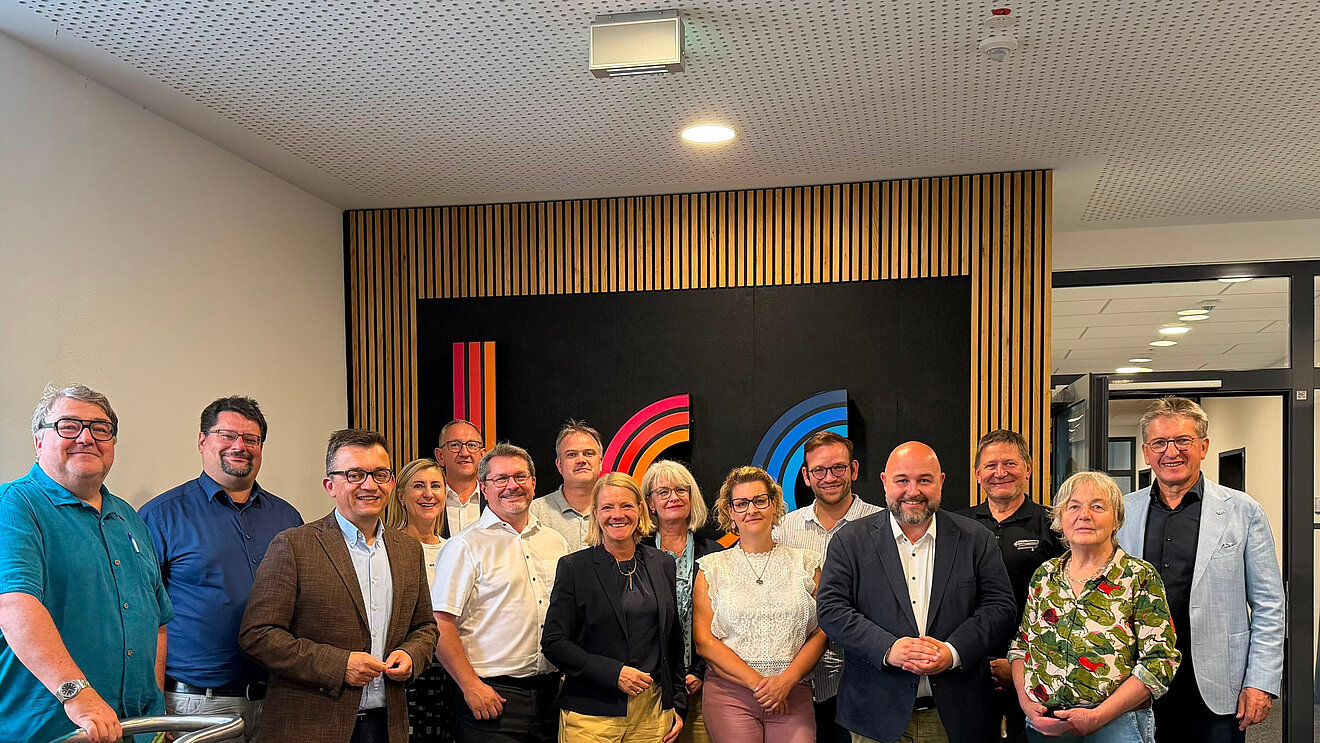
LCC Foundation Board Begins a New Term
The Board of Trustees of the Lucas Cranach Campus Foundation has begun a new term of office. Following the election at the constituent session of the district council, the 13 trustees met for their first session in Neuses. The board unanimously re-elected Jens Korn as its chair and Rudolf Kotschenreuther as vice chair. Three new members have joined the board: Sandra Wehrend, CEO of Sparkasse Kulmbach-Kronach; attorney Dr. Manuela Wittmann; and Member of the Bundestag Dr. Jonas Geissler.
Following his election, Jens Korn noted that while it is the Foundation Board’s mandate to oversee and advise the Executive Board, he also asked the members of the board to see themselves as advocates for the project: “Each and every one of us should also see ourselves as the face of the LCC.”
The reports from the two board members revealed the foundation’s deep roots in the district. According to board member Hans Rebhan, the approximately 250 guests at the celebration marking the university’s 10th anniversary represented many different segments of the district’s community: “Whether schools, the business community, or local governments, we have become a partner to many stakeholders in the region.” The foundation’s academic director, Prof. Tobias Bocklet, reflected on the event “Change in Upper Franconia: Innovation, Digitalization, and AI,” held in May. According to Bocklet, the keynote address by Federal Minister of Research Dorothee Bär made it clear that the LCC’s work is valued far beyond the district’s borders and should be seen as a great honor.
To strengthen the spirit of innovation in the region, the initiative is deliberately focusing on engaging with children and young people, according to Bocklet. Through the “University and Region” project, the initiative successfully reached a total of 325 participants in 19 workshops held at schools. The FabLab continues to aim for a broad impact throughout the region. The founding of the “Offene Werkstatt e.V.” association offers the opportunity for even more intensive user involvement. Tobias Bocklet also highlighted the close ties that exist with the local business community, particularly through the Technology Transfer Center (TTZ). For example, the “InProKi” project aims to ensure quality in industry through the use of artificial intelligence. The project relies in particular on chatbots, which are designed to learn from past mistakes. A total of 8.4 million euros in funding has been requested for the project.
For Hans Rebhan, creating attractive conditions for students remains a key priority on the foundation’s agenda. Among other things, he announced a roundtable discussion with the region’s restaurant industry. This is particularly important with regard to the School of Finance, for which the groundbreaking ceremony will take place in 2027: “Student life consists of more than just modern lecture halls and fully equipped laboratories,” said Rebhan.
Prof. Andreas Look’s presentation of the “Autonomous Driving” degree program sparked intense discussion. He highlighted how important internationalization is for the program’s development. For instance, a large proportion of the students come from abroad, particularly from India. The LCC offers excellent conditions with its model city in the Güterstraße building. Here, methods and technologies can be tested in a controlled environment. The professor sees another advantage in the strong connections with local industry. This opens up the opportunity to hire three additional staff members next year. Nevertheless, when asked by Oliver Skall, Look did not shy away from acknowledging that the environment is becoming increasingly challenging due to the weakness of the automotive industry. The goal is to counteract this by expanding the degree program to include humanoid systems and robotics. Rudolf Kotschenreuther addressed the competition with China. According to Look, the advantage of companies there is significantly less government regulation, which enables faster development. Dr. Manuela Wittmann expressed interest in the development of self-driving taxis. In her observation, the U.S. is significantly further ahead in this area than Germany. To close the gap, Look said, it is essential to collect and process significantly more data. In the professor’s assessment, students’ willingness to stay here in the region is very high. “Some people are even willing to put up with long commutes for this,” said Look.
Board Member Hans Rebhan presented the foundation’s outstanding financial performance. Thanks to prudent financial management and the acquisition of third-party funding, the LCC Foundation is in good shape despite its short history. The proper management of the foundation’s affairs was also confirmed by District Auditor Markus Wagner. The foundation’s board was therefore unanimously granted discharge for the year 2025. Foundation Board Chair Jens Korn took this opportunity to thank Rebhan and Bocklet: “Without your dedication, we wouldn’t be where we are today.”